
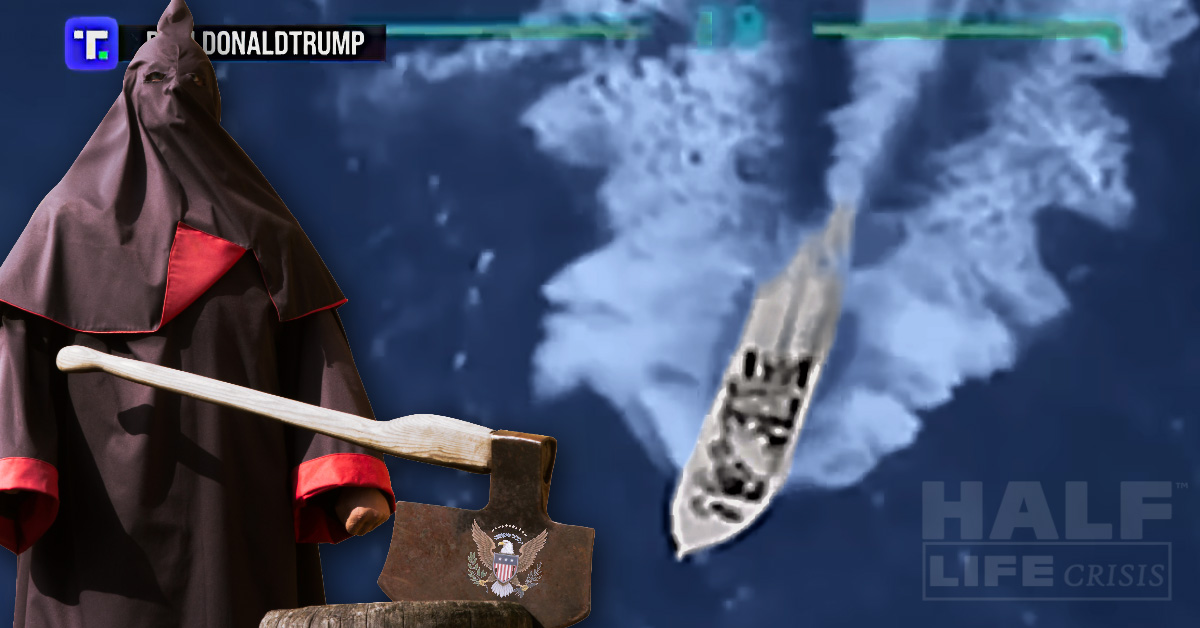
This article explains how sea interdictions really work, and why many US military members are lawyering up against what many consider unlawful military orders.
Maritime Interdiction 101
The Trump administration has conducted 13 maritime strikes against what they call narco‑terrorists from Venezuela. Trump has publicly claimed that each boat carried enough drugs to kill 25,000 Americans. The reasonable follow‑up question is: how do we know that claim is accurate? Don’t hold your breath — the official forensics to answer that question have not been released to the public.
Does that mean the methods and sources are classified? Maybe. I don’t have access to them, and even if I did, I would not disclose them here. But what I can tell you, as a former Navy intelligence analyst, is that the math is not adding up from this perspective. There are literally thousands of other ways to resolve these maritime interdictions that don’t involve blowing people up.
I’ll spare you most of the military jargon, but there are a few terms that will make it easier to connect the dots. This is important, because if you understand the process, you’ll realize it’s not a black‑and‑white issue.
For instance, aside from basic geography and physics, there are also several laws that must be followed before conducting any kind of maneuvering. That includes routine operations, such as simply traversing an area or choosing a course or speed in a particular body of water. I’m talking about instances where no shots whatsoever will be fired. Once ordnance is used, the stakes are a lot higher.

For example, when conducting naval fire exercises — whether small arms or the biggest guns — we have very strict rules to ensure nothing is hit by mistake. Likewise, if we’re conducting a strike, every bit of communication in that command and control (C2) chain will be recorded with every method of communication used for that operation. Guess what? Even when everything “goes well,” we debrief and figure out what could have been done better. And if somebody messed up, they get in trouble.
But what if the order itself is flawed? That’s the crux of this controversy. Military and civilian members with vast experience in this area have spoken out against this administration because — according to them — the U.S. Navy is committing what could be considered “war crimes” or “crimes against humanity.”
And although we learn about lawful and unlawful orders in Boot Camp and wherever officers gain their commission (Naval Academy, ROTC, etc.), this understanding becomes far more prevalent if a person is working in an operational specialty. Why? Because some of us were trusted with coming up with the plan of action, and it has to be legal in every way — and we have to be able to speak truth to power if the boss gets confused.
Military planning is not sexy. It’s laborious. It’s fascinating, rewarding, frustrating at times, and it is definitely teamwork. It might look sexy when deployed into action, but “making sausage” is a very comprehensive process. And yes, we have a JAG officer on speed‑dial because it gets complex. Each “stakeholder” — a fancy way to describe a crucial member of the team — is a Subject Matter Expert (SME) in their field, able to speak with encyclopedic knowledge. But what if SMEs are ignored or overruled? The mission goes the way of the dodo. A chain is only as strong as its weakest link.
For a Maritime Interdiction Operation (MIO), many factors must play in harmony. First, we have to know who our Vessel of Interest (VOI) is, and use available resources to follow them. Remember: international waters begin 12 nautical miles (NM) from the coast of any country, but the Exclusive Economic Zone (EEZ) for each country can extend to 200 NM. Technically, those are international waters, but there are still rules. Beyond 200 NM, you’re in the high seas — open waters where no country owns rights.

Does that mean you can commit any crime you want 200 NM out? No. You can’t commit crimes anywhere on this planet — or even if you somehow make it to another planet. For example, stabbing a fellow astronaut on the moon would still be murder.
So, to reframe: normally for an MIO, we’ve identified a VOI and have reasonable suspicion it’s carrying illicit cargo. We follow them, then attempt to board. How? With something called Visit, Board, Search, and Seizure (VBSS). Essentially, we get our warship close, and send a specially trained and armed team to board. If they’re uncooperative or hostile, we assess the situation and might send a special forces team — but in either case, they’re surrounded by naval firepower.
Once we board, we inspect the boat, take photos, compare biometrics, etc. If they’re clean, we send them on their way. If not, we hold them in custody. And even then, there are rules we must follow. The moment you have a person under custody, they become the responsibility of the entity that detained them — in this case, the US Navy. And yes, those rules shall align with international law and human rights.
Detainees are then given due process, which includes debriefing and potential interrogation. The point isn’t just to catch the “boat” — it’s to get closer to identifying the head of the organization, and use the seizure as evidence to grid a criminal operation to a halt. If you blow up a boat, you vaporize the people and the knowledge they carried in their own heads. That’s why we use VBSS, not strikes. It should be common sense.
Every single ship in the Navy has a VBSS team, and we can tag ‑ team with other military assets if boarding is considered too dangerous. And guess what? A VBSS team might discover someone on board being held against their will. But if you vaporize them with a missile or large ordnance, you’re potentially killing someone who should have been rescued.
You see why folks are lawyering up? It gets more complex. Let’s consider the following factors.

AUTHORITARIANISM AND PROPAGANDA The Puppet Master Tools
Revised Edition! Available on Paperback and Hardcover
Math, Physics, and Geography
So let’s deconstruct the claim from the Trump administration by using some good old simple analytical tools. Trump directed the Secretary of Defense and self‑proclaimed “Secretary of War” Hegseth to blow up boats leaving Venezuela, allegedly bound for the USA to deliver drugs said to be enough to kill 25,000 people.
We are talking about small boats with outboard engines crossing open seas for extremely long distances. So let’s do a bit of math and consider the geography.
Approximate distances (straight line, coast to coast):
- Venezuela (Paraguaná Peninsula) to Puerto Rico (Mona Passage area): ~1,000 miles (870 nautical miles)
- Venezuela (Paraguaná Peninsula) to Florida Keys (southern tip of Florida): ~1,300 miles (1,130 nautical miles)
- Venezuela (Orinoco Delta) to Florida Keys: ~1,400 miles (1,220 nautical miles)
Read those distances again — imagine you’re driving a car. Fourteen hundred miles is about the distance from New York City to Dallas, Texas, but at ~35 miles per hour. It already makes no sense.
The table above shows the “shortest” routes, but arriving in Florida would be more viable through the Miami–Fort Lauderdale area because of established drug corridors. That adds another six hours of travel (on car) from Key West to Fort Lauderdale, so still factor it at ~35 miles per hour — much longer overall.
So the next logical question is: how far can a small boat travel on a single tank?
- Fuel tank size:
- Small runabouts: 20–50 gallons for ~50–100 miles
- Mid‑size cruisers: 100–200 gallons for ~150–250 miles
- Larger offshore boats: 200+ gallons for 250+ miles if managed efficiently
- Burn rate (gallons per hour):
- A 200–300 HP outboard burns 15–25 gallons per hour at cruising speed
- At 25 knots, that translates to ~1 nautical mile per gallon
- Speed and load:
- Higher speeds or heavy cargo drastically reduce range
- Optimal cruising speed (not full throttle) maximizes efficiency
- Sea conditions:
- Rough seas or headwinds increase fuel consumption
- Calm waters allow closer to the theoretical maximum range
And remember: all the boats struck so far had at least two engines running at the same time, which means at minimum twice the fuel consumption. Even if someone claimed they would “mostly use one engine at a time,” the yaw would make the boat far harder to maneuver. So any gains in efficiency still require multiple refueling stops.
And before you argue that these boats can move faster, remember that physics sets the limits. The faster a boat goes, the more unstable the craft becomes, the more fuel it consumes, and the more it runs up against its intrinsic speed limit, known as hull speed. Beyond that, excessive speed makes the trip far more unpleasant and increases the risk of capsize.
Travel time:
If a fast boat ran from Venezuela to the United States, the closest continental entry point would be the Florida Keys, roughly 1,100–1,300 nautical miles away depending on departure. At a cruising speed of 25–30 knots, that’s about 36–52 hours of continuous travel — longer if seas are rough, the load is heavy, or evasive routing is used. And that’s nonstop, 24/7.
Puerto Rico, as U.S. territory, is closer at about 850 nautical miles, which would still take nearly 28 hours at 30 knots. The operational reality is that twin outboards burn 40–50 gallons per hour, so even with large tanks or auxiliary bladders, multiple refueling points are required. That stretches the trip into two to four days once you factor in fuel stops, crew fatigue, and weather.
Fuel weight:
Adding extra fuel to extend range comes with heavy trade‑offs. Gasoline weighs about 6.1 pounds per gallon, so 200 gallons in bladders or drums adds more than 1,200 pounds — over half a ton. Double that to 400 gallons and you’re hauling nearly 2,500 pounds, more than a ton of dead weight sloshing around the deck. That destabilizes the boat and still doesn’t solve the range problem, because twin outboards burn 40–50 gallons per hour. Even with auxiliary tanks, you only buy 8–10 hours of endurance before refueling again. In other words, the logistics of hauling that much fuel make the “straight shot” narrative implausible, and the payload math collapses under its own weight — literally, it affects buoyancy.
And by the way, gasoline fumes make the situation exponentially more dangerous. Because they are heavier than air, vapors settle at the bottom of the craft, where they can accumulate unnoticed. That means even a tiny spark — yes, even static electricity — could ignite them and blow up the entire boat.
Crew weight and provisions:
On average, there were five people per boat. At 160 pounds each, that’s 800 pounds before supplies. A single 55‑gallon drum of water adds ~459 pounds of water plus 25–48 pounds for the drum itself, totaling ~484–507 pounds. Add food, spare fuel, tools, and emergency gear, and you’re easily north of 1,400–1,500 pounds just for crew and water. Without cargo or weapons, you’re already carrying ~3,700 pounds on average, which directly impacts range.
Drug payload math:
The administration claims these boats carried fentanyl “enough to kill 25,000 people.” That fits in a small bag. A commonly cited lethal dose for an opioid‑naïve person is ~2 mg. At that rate, 25,000 × 2 mg = 50,000 mg = 50 g. That’s less than a pound, with the volume of a few tablespoons. Other drugs vary widely in lethality, but the point is that these “death equivalence” claims assume fixed doses, uniform purity, and zero tolerance across 25,000 people — all unrealistic. Even if we take the fentanyl figure at face value, the logistics problems (fuel, crew, water, range) don’t hinge on carrying 50 grams — they hinge on whether the boats, missions, and interdictions align with lawful process and evidence.
So does it make sense to put a small boat full of fuel — a literal death trap if a spark flies — through a grueling Caribbean crossing to carry a bag of fentanyl weighing less than a pound? And if there are two bags, that’s 50,000 deaths, not 25,000, which makes the figure inconsistent.
Sea conditions:
The Caribbean is not an easy body of water to navigate. Even our warship rocked like a rollercoaster at sea. It might look pretty from the coastline, but conditions change quickly offshore. Far from the postcard image of calm turquoise waters, the Caribbean is a gauntlet of trade winds, strong currents, and unpredictable weather systems. Even on a “normal” day, four‑to‑six‑foot waves are common in open water, with confused seas near island chains, while squalls and tropical depressions can turn conditions dangerous in minutes.
Even Libertarian/Republican Senator Rand Paul briefly noted that it makes no sense for any little Venezuelan boat to make this journey. I figure I could expand on that claim with the math.
But wait — there is much more that makes this saga problematic to any seasoned military personnel who understand the rules, and also understand that leadership is temporary, but consequences are permanent.

WOKE & PROUD The Charlatans' Inconvenience
Available worldwide on eBook and Paperback
A Strategic Self‑Checkmate
As you can see, this article is intentionally longer. Even when oversimplified for brevity, it should be obvious that several lines of effort and calculations are required to ask and answer even the most basic questions behind the administration’s claims used to justify these strikes.
As a veteran, I am concerned that if I can easily debunk these claims from here using basic geography and arithmetic, why are Navy leadership and Congress not breaking this down in the same way? People are literally dying.
Any claim that the administration is trying to stop drugs from coming to America misses an important point: why do drugs come to the USA? Because there are consumers who pay more than in other markets for the same drug. In other words, it would make more sense to curb addiction in America and prevent drug use. A common reason people use drugs — legal or otherwise — is as an “escape” from something. Call it recreation, call it coping; whatever it is, the drug is replacing something in their current reality. That is a topic for another article, but it is worth considering.
Let’s talk about the flawed strategy of blowing people up instead of conducting a Maritime Interdiction Operation (MIO). Any boat has a point of origin and a point of arrival. By seizing — alive — an alleged trafficker, the administration could learn their routes and chain of command. You can be sure the “drug‑lord boss” will never be the one boarding that boat.
Even if you claim they refuel on islands along the way or use motherships, blowing them up negates the opportunity to catch the bigger fish — unless that is the intent. But then you’re not fixing the problem; you’re patching a tire while it’s still rotating. It is ineffective.
So let’s deconstruct this: Trump’s claimed mission is to “stop the drugs from coming to America.” Then they should be stopped at the source before they ever depart America. That means identifying the point of origin, not just the point of departure, though both matter. It is logical to assess that traffickers’ routes are not random but carefully planned around logistics such as transporting and loading drugs onto boats.
If these boats stop in ports along the way, blowing them up prevents us from learning where they are stopping. In other words, if you can monitor a boat, you can monitor its destinations — whether another Caribbean nation or even a U.S. territory.
In the Caribbean, the United States has two inhabited territories: Puerto Rico and the U.S. Virgin Islands, plus the uninhabited Navassa Island near Haiti. Puerto Rico is the closest U.S. territory to Venezuela, lying about 850–1,000 nautical miles (roughly 1,000 miles) from the Paraguaná Peninsula depending on the route. The U.S. Virgin Islands — St. Thomas, St. John, and St. Croix — are slightly farther east, about 1,100 nautical miles (1,250 miles) from Venezuela. Navassa Island is uninhabited but sits in the northern Caribbean near Haiti, roughly 700–800 nautical miles away.
In practical terms, Puerto Rico is the nearest U.S. territory for any crossing attempt, while the Virgin Islands are a longer haul, and both are daunting distances for small fuel‑laden boats.
And then there is the question of how small boats could infiltrate U.S. waters or territories. We have the U.S. Coast Guard, sophisticated radars, and layered maritime domain awareness. If a boat were a vessel of interest (VOI), it would be easy to interdict once it attempted to enter territorial waters illegally.
The benefit of interdiction is clear: you gain evidence, testimony, methods, and sources, while denying the adversary that course of action in the future. The moment you vaporize a boat, you lose all of that — and you place the Sailors and Officers tasked with the strike in legal peril.
For your convenience, here are the laws and conventions that experts have raised as being violated by the current administration:
Resources
- United Nations Convention on the Law of the Sea (UNCLOS, 1982)
Defines maritime zones, rights, and duties of states at sea. Includes obligations such as freedom of navigation and the duty to render assistance to those in distress (Article 98). - Rome Statute of the International Criminal Court (1998)
Establishes the ICC and codifies crimes against humanity (Article 7) and war crimes (Article 8), providing the legal framework for tribunals similar to Nuremberg. - Geneva Conventions (1949) & Additional Protocols
Core humanitarian law treaties protecting civilians, prisoners of war, and those at sea. Convention II specifically addresses protections for wounded, sick, and shipwrecked members of armed forces at sea. - International Convention for the Safety of Life at Sea (SOLAS, 1974)
Sets minimum safety standards for ships and obligates states to ensure vessels safeguard human life at sea. - International Convention on Maritime Search and Rescue (SAR, 1979)
Creates a global framework for search and rescue operations, requiring states to coordinate and assist persons in distress at sea. - International Tribunal for the Law of the Sea (ITLOS)
Judicial body that adjudicates disputes arising under UNCLOS, including cases involving maritime safety, environmental protection, and human rights at sea.
It boggles my mind that Congress and their staffers have not pieced this together — even before Trump threatened legislators who spoke about disobeying unlawful orders. Share this with your legislator if you wish. I am no partisan; this is not about politics. It is about understanding reality — and applying common sense.
What Is Trump Really Ordering?
The Uniform Code of Military Justice (UCMJ), under Article 92, is very specific about what are considered unlawful orders. It mandates U.S. military forces not only to refuse to follow them, but also to report these violations. As I’ve said in a previous article: a senior person can delegate the task, but not the responsibility. A crime remains a crime.
The Law: “Failure to Obey Order or Regulation.” (10 U.S.C. § 892 – Article 92) Any person subject to this chapter who—
- violates or fails to obey any lawful general order or regulation;
- having knowledge of any other lawful order issued by a member of the armed forces, which it is his duty to obey, fails to obey the order; or
- is derelict in the performance of his duties;
shall be punished as a court‑martial may direct.
So, let me put this in basic terms. If the person issuing the order has already violated a statute, then that order is unlawful. Everyone who follows that unlawful order becomes a de facto accomplice. But then comes the harder question: who ends up directly with blood on their hands? The one who pulled the trigger.
See why military folks are lawyering up? With good reason. Trump is well‑known for throwing even his most loyal followers under the bus the very second they become inconvenient. That already happened. The moment the goalpost could not be moved any further on these war crimes and crimes against humanity, Trump began blaming the admirals — particularly Admiral Bradley. And Hegseth is now distancing himself from these strikes.
For example, the crime against humanity of giving “no quarter.” After the report that SEAL Team Six was ordered to double‑strike survivors clinging to life after their boat was destroyed by sophisticated U.S. Navy weapons — that is a crime against humanity. Somebody will be held accountable for that, whether Trump is in office or not. Likely once he is out of office or as a result of impeachment.
To emphasize: “no quarter” — meaning deliberately denying mercy to survivors — is explicitly prohibited under the Geneva Conventions (Convention II, Article 12 and Protocol I, Article 40). Ordering a “double strike” on survivors falls under crimes against humanity, and tribunals have prosecuted such actions before.
That means Trump was really asking — however the order was delegated — that a U.S. Navy Petty Officer would “push the button,” the functional trigger that ends lives without due process.
And in doing so, the entire chain of command on that watch station and that naval asset was compromised. For example, if the Tactical Actions Officer (TAO) authorized the release of ordnance under the Commanding Officer’s (CO) directive, that order still originated higher up. Potentially from the Commodore, who reports to the Strike Group Commander, who coordinates with the Combined Combat Commander and/or Fleet Commander — in this case, Southern Command and/or Fourth Fleet — who in turn reports to Fleet Forces, and ultimately to the Pentagon. Which means Hegseth, and Trump as Commander in Chief.
In other words, what we are seeing in real time is Trump trying to punish those who spoke about unlawful orders. In fact, Hegseth is threatening Senator Mark Kelly (D‑Arizona), a retired U.S. Navy Captain, decorated combat veteran, and astronaut, to return to active duty just so he can court‑martial him — and further threatening any retiree who agrees with Kelly with the same fate.
But now that the walls are closing in, what many of us predicted is happening. I wrote an article about unlawful orders before. That is what I meant.
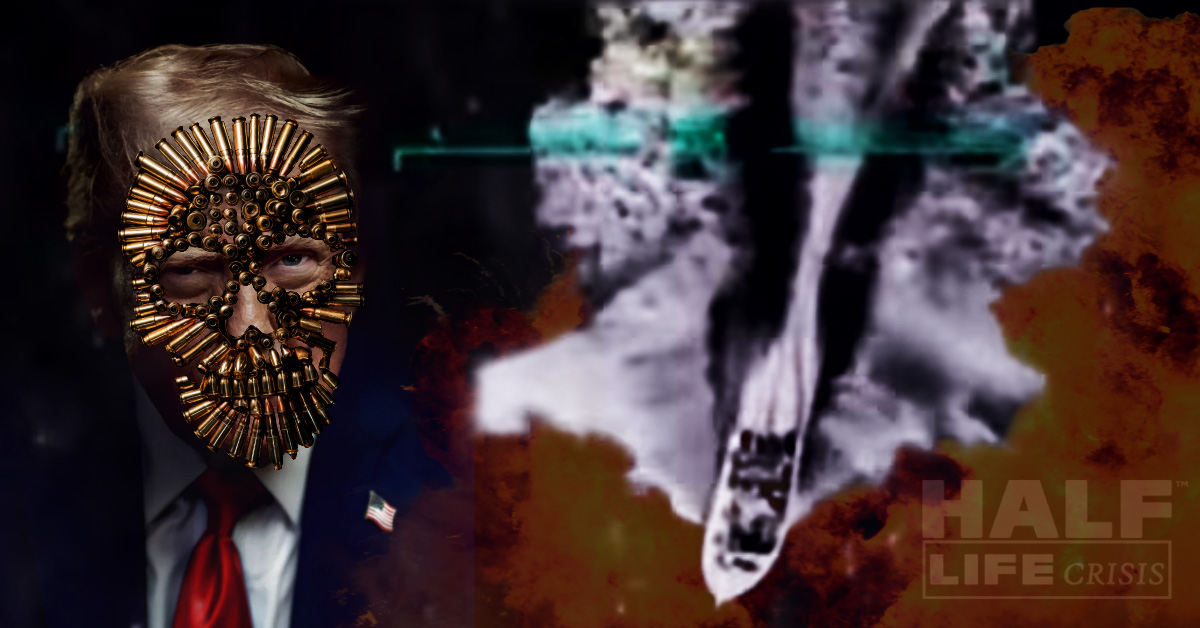
Military lawful vs unlawful orders
Military commands must always be lawful. The post‑WWII Nuremberg trials proved “just following orders” is never defense for crimes against humanity.
Does Trump’s Claim Make Sense?
It does not. Mathematically, geographically, logically, strategically, or any other way you want to measure it — it is incoherent by definition. These operations in the Caribbean Sea are not only a huge waste of naval assets and manpower, they are based on false pretenses.
For the MAGA folks, let’s put it in money terms. Trump deployed the USS Gerald R. Ford (CVN‑78) — the largest aircraft carrier on Earth. It costs about $7,000,000 per day to operate.
But it is not alone. It has about half a dozen ships with it, each burning on average $1,000,000 in fuel per day. All to chase and destroy, so far, 13 small boats. The first strike was on September 2, 2025.
The Ford began her deployment on June 24, 2025, heading to the Mediterranean — near actual wars in Ukraine and Israel. But on October 24, 2025, she was redirected to Southern Command and arrived on station November 11, 2025. That means the Ford alone, under “Operation Southern Spear,” has cost the U.S. $273,000,000 in just 39 days since being redirected. And now she is in St. Thomas, U.S. Virgin Islands, for a port visit with all 4,500 personnel onboard. I’m not against port calls; I’m pointing out how unsound this entire military strategy is.
Retiring military members speak openly about how dysfunctional the Pentagon under Hegseth has become. I’ve said it before, but it bears repeating: the role of the military is to prevent wars, not to start them.
Oaths of Service
Enlisted Oath:
I, [name], do solemnly swear (or affirm) that I will support and defend the Constitution of the United States against all enemies, foreign and domestic; that I will bear true faith and allegiance to the same; and that I will obey the orders of the President of the United States and the orders of the officers appointed over me, according to regulations and the Uniform Code of Military Justice. So help me God.
Officer’s Oath:
I, [name], do solemnly swear (or affirm) that I will support and defend the Constitution of the United States against all enemies, foreign and domestic; that I will bear true faith and allegiance to the same; that I take this obligation freely, without any mental reservation or purpose of evasion; and that I will well and faithfully discharge the duties of the office on which I am about to enter. So help me God.
Note: Both oaths require every person to “support and defend the Constitution of the United States against all enemies, foreign and domestic.” Every occupant of an office is temporary. America is only the land of the free and home of the brave if her people place accountability over partisan loyalty. Nowhere in the oath does it say to hold party over country.
Final food for thought:
Any leader giving an order must stop and think: what are you really asking someone to do? Would you, as a military member, order someone under your command to commit sexual abuse? No — that would be illegal. So what makes it legal to kill, without due process, a group of human beings in international waters? Both are heinous and indefensible crimes.
Congress, what else do you need to act? These strikes took place approximately 300–340 nautical miles off Venezuela’s coast, just outside its EEZ, in international waters — nowhere near the United States or any U.S. territory.
The same with the strikes in the Pacific, 200–300 nautical miles off Ecuador, Colombia, and Panama. Supposedly because they were navigating drug corridors. So why not seize them and dismantle their operations instead?
In America, everybody is innocent until proven guilty. If a vessel is identified 300 miles off the coast, it can be tracked as it gets closer. If detained, the drugs can be seized. Yes, some boats are sunk after seizure to prevent them from becoming hazards to navigation — but that is different from deliberate destruction and de facto murder without due process.
I hope this article — however long — was educational. I’ve kept it simple, but the point is clear: the situation is not as crude as the administration claims. And if this took time to read, imagine how long it would take to properly plan an operation effectively — without it becoming a crime against humanity.
Trump and Hegseth may delegate the task, but they cannot dodge responsibility forever — unless Congress remains inept.
Oh, wait. We might be cooked – giving Congress recent historical effectiveness record. HLC
 About the Author: J. Marcelo "BeeZee" Baqueroalvarez
🔗 Connect & Learn More: Visit Marcelo's comprehensive landing page for his extended bio, social links, consulting form, and more.
J. Marcelo "BeeZee" Baqueroalvarez is the Founder of Half Life Crisis™, a unique father-daughter collaboration dedicated to the relentless pursuit of intellectual honesty, critical thinking, geopolitical strategy, and meaningful art. Marcelo is the recognized author of the essential reads, Authoritarianism & Propaganda and Woke & Proud, driving challenging conversations worldwide. When not publishing, Marcelo utilizes his strategic insight in technology and business as the founder of BeeZee Vision, LLC™, which includes BZVweb™ Automated Web Services and Info in Context™ strategic consulting.
Continue the Conversation
We encourage intellectual debate! To maintain a clean, focused reading experience, comments have been disabled on this article. Share your insights, counterarguments, or continue the discussion on your preferred social platform:
Facebook • Instagram • LinkedIn